|
Data entry cells are light blue in color. At A37 is an inch to millimeters converter. All lengths are to be entered in millimeters. 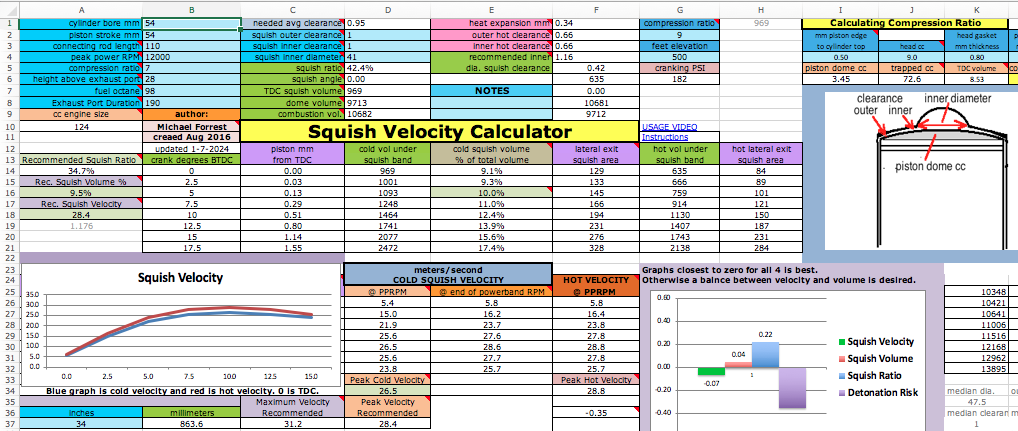 Usage Steps: 1) enter cylinder bore 2) enter piston stroke 3) enter connecting rod length (typical is twice the stroke) 4) enter peak power RPM. 5) enter compression ratio (the cylinder/head volume when the piston edge is even with the top of the exhaust port divided by the cylinder/head volume when the piston is at TDC) if you know it, or use the calculator at the bottom left of the sheet. 6) enter millimeters from top of exhaust port to "deck" (where the top edge of the piston is at TDC) 7) enter the octane of your fuel (MON + RON)/2 or RON x .96 8) exhaust port duration 9) enter the outer squish clearance (piston to head clearance at the far left or far right of piston) 10) enter the inner squish clearance (piston to head clearance at the inner portion of the squish band) 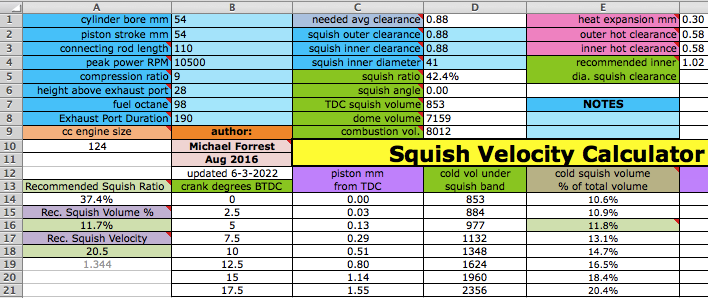 11) enter the inner diameter of the squish area 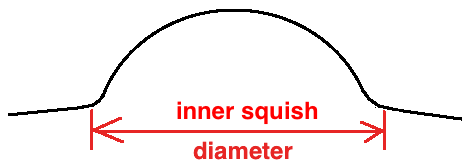
12) Compare the recommended Squish Clearance at D1 to what you have entered at D2 and D3. D1 will get your squish volume at E16 nearly equal to what is recommended at A16. The squish violume determines the burn time after peak combustion pressure. 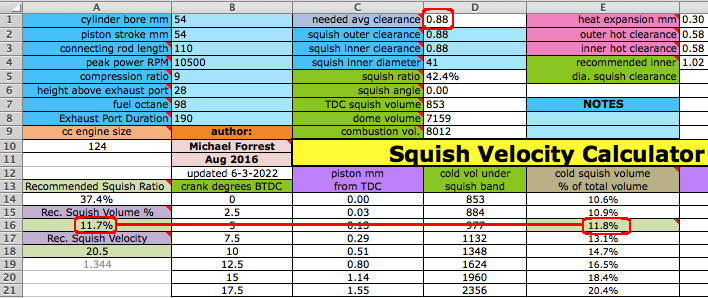 12) Without manipulating the squish ratio at D5 then the perfect squish volume often throws off the squish velocity at D34. It should be the recommended value listed at D37. So usually you have to change the squish clearance for a compromise between the volume and the velocity. Raising the clearance raises the volume and decreases the velocity. But if reducing the squish band size gets you closer to perfection without compromises then just do that. If you need a fatter band then unless you find someone good at adding aluminum to a head then you are stuck with what you've got. 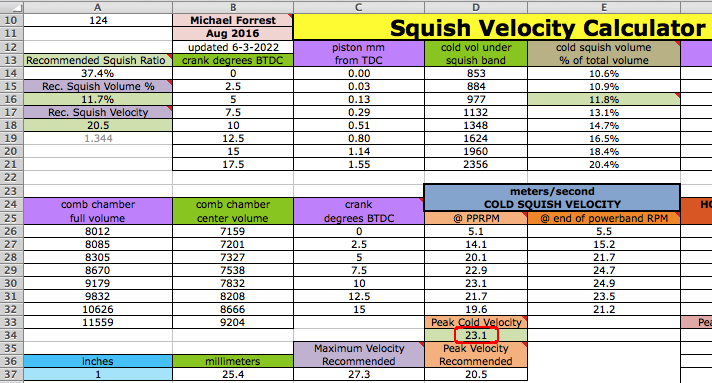 Don't reduce the clearances so much that the hot clearances at F2 and F3 are less than .4mm, otherwise you may encourage detonation. 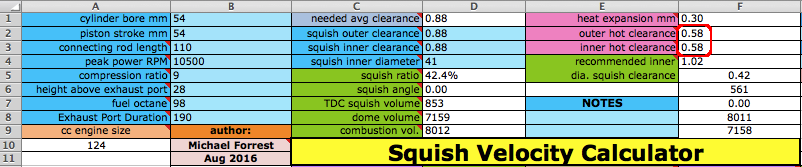 If the cold or hot velocity is too high then warning messages will display. 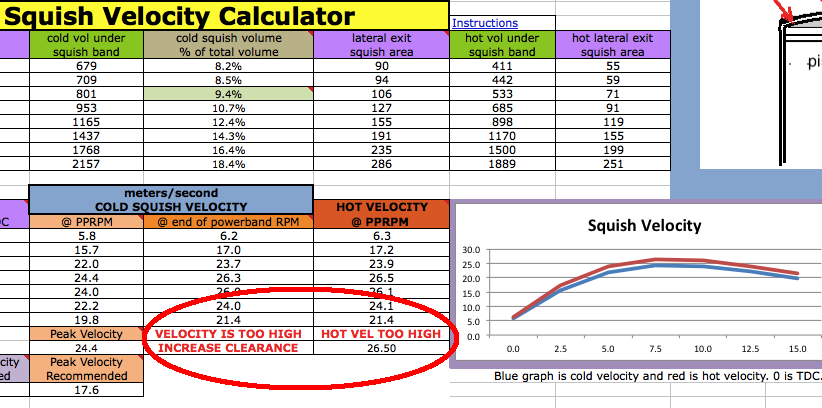 If you increase the squish velocity then you have to retard the ignition (make it happen later). otherwise the peak pressure happens too early which can cause detonation. It also causes a power loss due to excess pressure the piston has to push against on its way to TDC. 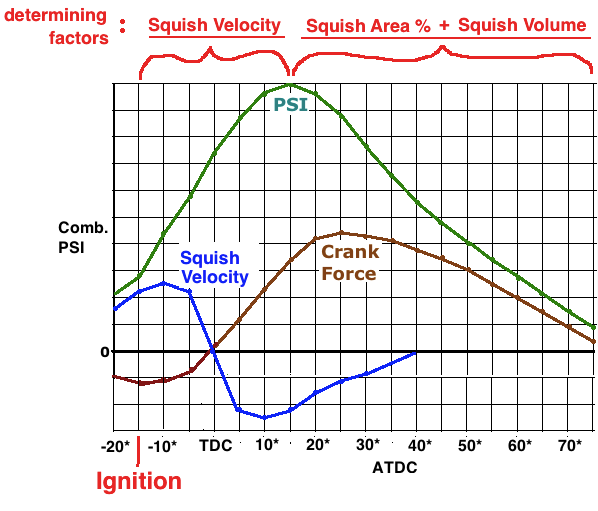 my Youtube video about this: YouTube The spreadsheets hidden comments are all listed below for you to read in case your computer doesn't let you read all of them. Cell Comment Text $G$1 Enter "m" for milliliters per liter, or "o" for ounces per gallon. $H$1 Enter "y" if you want the fuel/oil ratios lowered by the rating of viscosity modifier in column F. $H$3 Enter 1 for easy riding, 2 for moderate riding, and 3 for extreme riding. $B$4 Average of the base oils (excluding group 1) flash temperatures moderated by the % of the product those oils occupy. This needs to be higher than the temp at J19 to be able to protect the upper cylinder. $G$4 Cost per liter times 3.79 divided by fuel/oil ratio. So this gives the cost of oil that needs to be added per gallon or liter according to the displayed fuel/oil ratio. Use it to compare to other oils if interested in spending less money on oil. Make sure the present cost per liter of the engine oil is entered in column L at the same row as the oil. $K$4 This is by the cylinder temp estimated by the spark plug heat range #. $L$4 Cost is in US dollars. 1 liter = 1 quart x 1.05 $B$5 Groups of oil it is made of. Group 1 and 2 are mineral oils. Group 4 and 5 are synthetic oils. $C$5 Click onto I72 to go to web site for calculating this viscosity from the 40C and 100C viscosities $D$5 Click onto I72 to go to web site for calculating this viscosity from the 40C and 100C viscosities $E$5 This is an average recommended ratio to use. Higher ratios for light trail/street use are OK if the engine is never maxed out for very long. This ratio is based on the listed viscosities for the oil which is recalculated for the estimated upper cylinder temperature. Although some oils will show ratios in the 60's or 70's I personally never use less oil than 60/1 on any motorcycle because there's some benefits to a certain minimal amount of oil presence. Also the higher the # for it in the F column, the higher the amount of viscosity modifier it has, and it is unknown to me if that artificially boosted viscosity increases the engine protection, or if they added it just to make it look better on the spec sheet. So when I use an oil I will use a lower fuel/oil ratio than is recommended here if the viscosity modifier rating # is high. These are just educated guesses based on what limited information is available but in some of these examples if you divide the recommended ratio by the VM rating you will get a more realistic ratio. Also the fuel/oil ratio is figured w/o the group 1 oil if there is any. That is because group 1 immediately flashes off of the hot upper cylinder. It's only benefit is for the bearings which like light oil. To double check the recommended ratio you can judge it by the amount of spooge produced (unless your pipe catches it all and no matter what then you don't see spooge). The best ratio usually produces just a little spooge. $G$5 Acceptable oils will show their cost if they have an average flash point temp higher than the cylinder temp at J19. Oils with more than 20% group 1 oil and that don't have a FD rating won't show their cost after you entered "Y" in the power valve question cell. FD assures more detergent additive to prevent as much carbon formation that is the worst with group 1. Oils with too much group 1 oil and/or too high a VM rating won't show in this column if an NGK plug over their highest rated # is used. Some of those viscosity modifiers break down with very high engine heat which ruins the oils lubricity. $H$5 Enter W for water cooled, or A for air cooled. $N$5 This changes all ratios. It's non-changeable except by Michael Forrest. $H$8 A squish band lowers the upper cylinder heat. This calculator lowers the estimated upper cylinder temp by 15C if there's a squish band. $H$11 Oils with 40% or more of group 1 oil are too dirty for power valves and are not recommended here. Columns AF and AH show the % of group 1 oil in the product of the same row in column A. $H$14 This % affects the need for oil because ethanol tends to wash off oil from metal surfaces. So with more ethanol a lower fuel/oil ratio is calculated. $I$18 Oils are recommended in column H according to the plugs NGK heat range and the oils average flash point temp. Higher #'s are for hotter engines which need an oil more resistant to heat (an oil with more synthetic or castor in it). Half sizes are accepted here also. Don't enter the # you prefer to use. Enter the # that causes the color to change on the ground electrode at the halfway length. This cell accepts #7 to #11. $H$32 Thickness at the inner part of the ring, opposite the surface contacting the cylinder. $H$35 Ring thickness at the cylinder contact surface. If you don't know the thicknesses then leave them both at 2. When #1 is thicker than #2 then the pressure per area increases which warrants more oil. $A$91 Put the engine oil maker and product name in the A column, the 150C viscosity in the C column, the 200C viscosity in the D column, and the cost per liter in the L column. This section can't adjust the fuel/oil ratio for presence of group 1 mineral oils. $B$103 This can help you know how much more gasoline to add for an increased gas/oil ratio, or how much oil to add with additional gas for the same ratio. Also it figures how much oil to add w/o additional gas so the gas/oil ratio can be lowered to a value you enter at C109 or E109. $A$109 Density of engine oil for calculating metric or imperial. Density is the fraction of weight it has compared to the same volume of water. $B$109 Milliliters of engine oil $D$109 Ounces of engine oil $B$116 The normal range of gasoline per liter is between 0.71 and 0.77 kg but it's best to measure it with a weight scale. $D$116 Measure this with a weight scale. By volume this is 128 so you can enter that in place of measuring it if you're in a hurry. $B$119 This is the grams of gasoline that you want to add oil to. $D$119 This is the ounces of gasoline that you want to add oil to. $B$120 This is the calculated liters of gasoline for the values above. $D$120 This is the calculated gallons of gasoline for the values above. $G$146 This is a way to verify that your measuring cup is accurate by pouring the calculated weight of oil into it and seeing if the resultant amount is what it should be according to your gas/oil ratio. $F$147 Oil for I148 $G$147 Weigh a volume of water that is probably more than the volume of oil you will be adding to the gasoline. If you know the density of the engine oil then just skip this step and read the comment for H148. $J$147 Grams of the same volume that was used to find the value at I147. $G$148 Weigh the oil you will use that occupies the same volume that the water occupied. If the oil specs list density then just multiply the density by the value at I147 to get this value. For instance, if the density is .87 and the value at I147 is 100 then this value will be 87. $H$149 Ratio you want to use for this oil. $J$149 Gas density ranges from .71 to .77 kg per liter. $H$150 Liters of gasoline that you want to add oil to. You can measure this or get it from K151. $J$150 This is the grams of gasoline that you want to add oil to. $N$150 You can store the needed ratios for your ride here. $O$150 This is I148 divided by I147. $G$151 This is the weight of oil needed to mix in with the liters of gasoline entered above. Be sure to swish around gasoline in the container after pouring out the oil. This will get all the oil which is important when measuring for a small mixture volume. $J$151 This is the calculated liters of gasoline for the values above. Enter this value at I150 if you are using this method instead of measuring the amount of gas. $G$158 This is the weight of oil needed to mix in with the gallons of gasoline entered above. |