|
My latest test results are explained in my videos: Does More Mineral Oil Increase Power? Does More Synthetic Oil Give More Power? Does More Castor Oil Improve Power? Does Maxima Castor 927 give more power at 32/1? 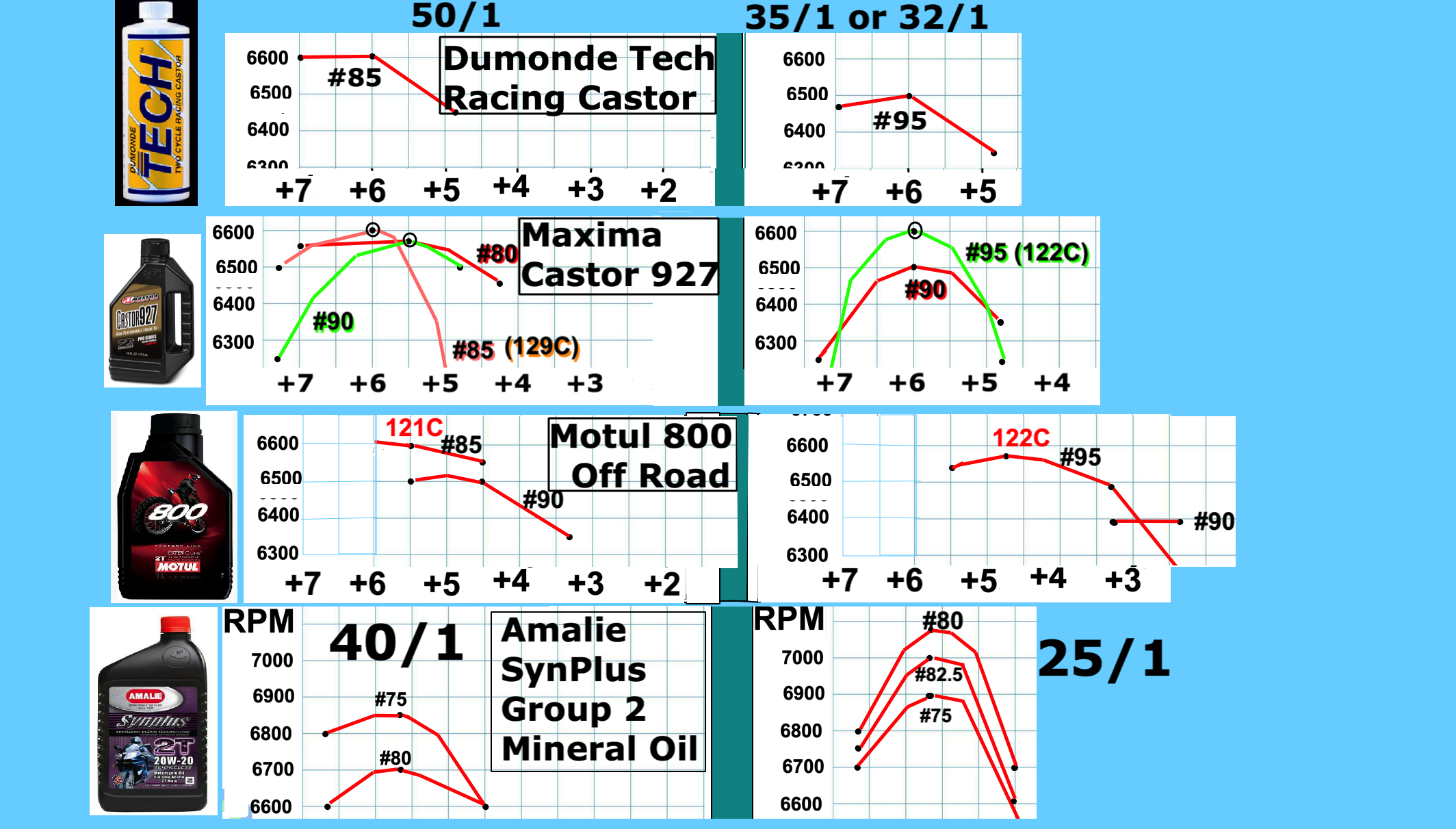 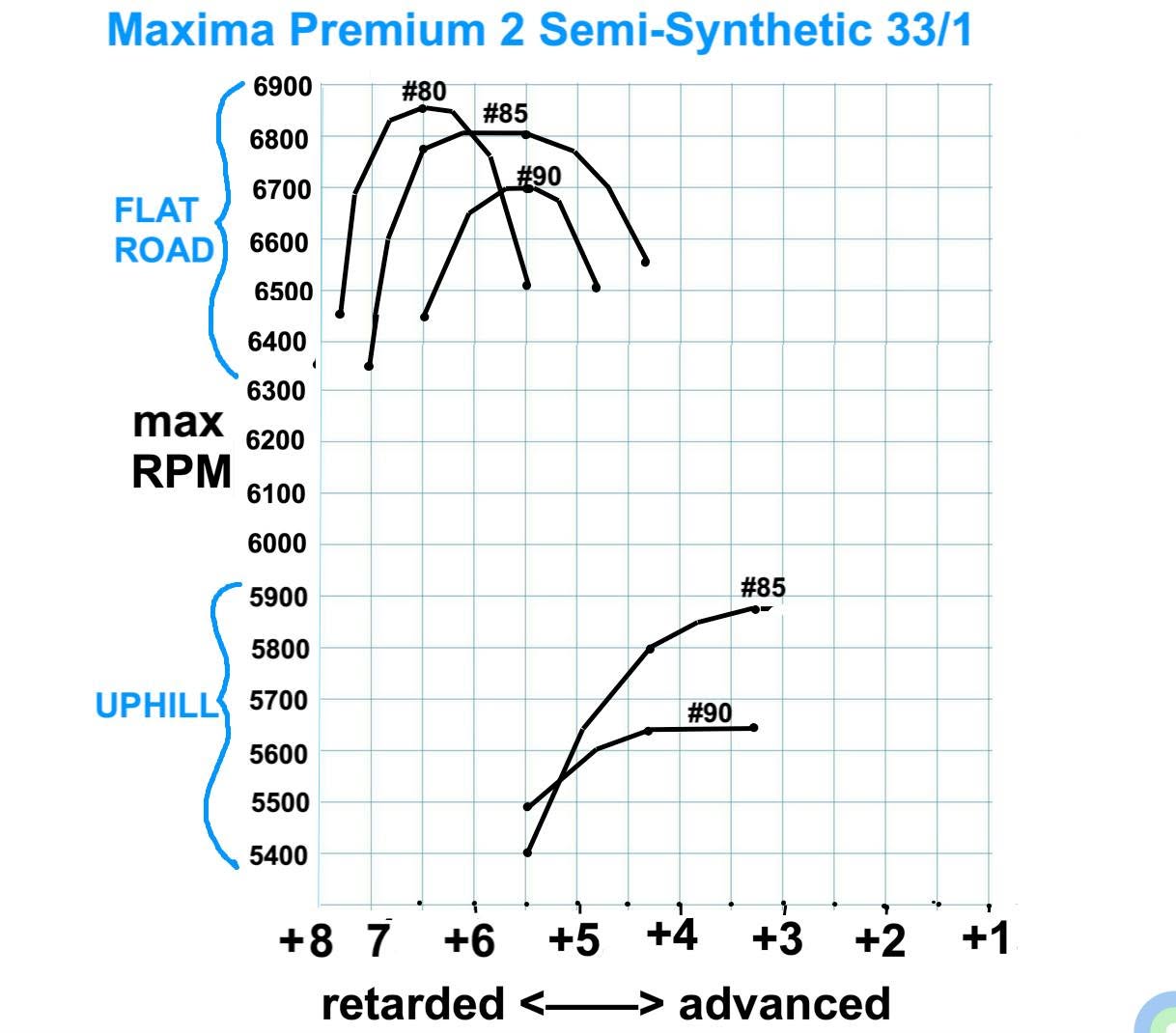 CONCLUSIONS 1. Synthetic Oil (Motul 800) Power Output and Ratio: Changing the fuel/oil ratio from 50:1 to 35:1 resulted in less than a 1% difference in RPM (0.8%) which shows that more synthetic oil does not give more power. Tuning Requirements: Synthetic oil is a "slow-burn" oil. Adding more oil makes the fuel-oil mixture more dense, requiring a larger main jet (jumping from an 85 to a 95 jet) and requires you to advance the ignition timing to maintain peak power. Timing Stability: Synthetic oil is timing-unstable; changing ratios significantly alters the engine’s timing needs. Engine Temp: More synthetic oil noticeably lowered cylinder head temperatures (from 116°C down to 110°C). I think this is because thick synthetic oil creates a thermal insulating layer on top of the piston which limits the amount of heat it and the head absorbs from the combustion heat. 2. Mineral Oil (Amalie SynPlus Group 2) Power Output: Testing at 40:1 vs. 25:1 showed a 3% difference, possibly indicating that more oil increases power. Timing Stability: Unlike synthetic, mineral oil demonstrated stable timing needs across different ratios when using a correctly sized carb. (This stability didn't exist with the too-small 14mm Dellorto.) Overall Performance: In your comparative summary, your engine actually favored mineral oil the most, hitting your highest observed peak of 7,800 RPM. 3. Pure Castor Oil (Dumonde Tech / Klotz Benol) Power Output: In your dedicated test comparing pure castor oil at 50:1 vs. thicker ratios, the difference was only 1.5%. You noted you were initially disappointed because you expected the classic Gordon Jennings "more castor = more power" rule to hold true, but concluded it was basically equal within your margin of error of 3%. The Theory: Castor oil is a "fast-burn" oil that carries its own oxygen molecules, effectively leaning out the engine and requiring up-jetting. Because it burns fast, it allows you to retard the timing, meaning the piston fights less pressure on the upstroke. 4. Castor/Synthetic Blend (Maxima Castor 927) Power Output: Testing 50:1 vs. 32:1 yielded identical top RPM results (6,600 RPM). More blended oil did not increase power. Timing Stability: Like pure mineral oil, the castor blend showed stable ignition timing needs (only a negligible 1.5-degree variation). More Conclusions The "Carb-Sizing vs. Timing Stability" Breakthrough In the mineral oil video, I noted that the smaller Dellorto carb required varying timing changes across jet changes, while the correctly sized Mikuni 18mm kept timing needs completely stable (the flat top of your atomization bell curve). This means timing instability isn't just an inherent property of the oil; it is amplified by poor carburetor atomization. A restrictive or undersized carburetor destroys timing stability across different fuel-oil ratios, whereas a correctly sized carburetor buffers the engine against those shifting timing demands. The High-RPM Castor Paradox I mentioned that my test engine is a relatively low-RPM unit, which is why it likely favored the mineral oil (7,800 RPM) and didn't see a power bump from more castor oil. The Trail-Rider’s Compromise I noted that synthetic lowers head temperatures but creates massive spooge at 32:1, whereas mineral oil runs cleaner at correct ratios but leaves harder carbon deposits over time. The missed conclusion: For a non-racer, my data maps out a perfect trade-off formula. If a user doesn't want to test and modify their mechanical timing advance, a semi-synthetic blend or Castor 927 at a leaner ratio (45:1 to 50:1) is scientifically the best "set-and-forget" option. It grants the timing stability of mineral/castor with the clean-burning traits of a synthetic. |